Showing posts with label Vacation Education. Show all posts

Thursday, August 14, 2025

Finding Hope: From Brokenness to Restoration by Heidi Goehmann; a book review


"Hope isn’t really hope until you need it,” Goehmann says in her book titled Finding Hope. Christ is the hope that comes in the brokenness of our lives. The brokenness of sin – our own, the sin of those around us, original sin, and the labor pains of a fallen world. Christ is there in the midst of it, redeeming us, redeeming the whole world.

This is the gist of her message woven throughout this hundred and fifty page book. The hope she speaks of is the hope we see in Romans chapter 5, where we read, “…suffering produces endurance, and endurance produces character, and character produces hope, and hope does not put us to shame, because God’s love has been poured into our hearts through the Holy Spirit…” (See Romans 5:3-5)

The world needs this hope, we need this hope, to know that brokenness can be healed. When we are honest about our brokenness we unveil if from the shame and blame that cloaks it, and we bring it into the light so it can be healed. Brokenness makes us ask God “Who am I? Because if I am Yours, then why all of this?” Brokenness makes us ask “Am I worthy of being loved?”

Goehmann, a licensed clinical social worker and mental health care provider, says we need to learn to name the brokenness, and part of that is being honest about how we feel. When we hold in our emotions – our bodies take the brunt of them in stress, tension, and inflammation. We get into trouble when we let our emotions boil over onto others – our feelings should not lead the way in our decision making, and yet in our brokenness, they often do. The Holy Spirit is our Counselor and God’s Word is our guide. These speak truth, hope, and love when our emotions speak all sorts of other things.

We walk a broken journey with an unbreakable Savior, Goehmann is quick to remind us.

When we gather around God’s Word, we are reminded of Christ, who speaks hope over brokenness. With His Word and by His Spirit, we can walk through brokenness. We rejoice in hope, in the glory of God. Even in Christ, the race we run in this life is not easy. Imagine how hard it is to walk through this life of brokenness without Christ. That is why we share Christ with others. To give them Hope. We raise the banner of Christ for the world to see. We raise it over the darkness and brokenness that surrounds us and our neighbors.

We cannot avoid brokenness; to try to escape it is to heap unrealistic expectations of perfection upon ourselves and those around us. We often work to make our families “appear” to be without brokenness, and this is dishonest. It prevents us from getting the help we need, forces us into isolation, and causes increasing anxiety. It also forces us to carry shame and leads us to avoid relationships with other Christians who can comfort us with the hope that is in Christ.

The light of Hope is more clearly seen when we confess our sins and acknowledge our need for a Savior. Perfect people do not exist in this world but forgiven and loved people do. God brings hope to us all and gives us an Identity in Him. We look out into our broken communities that need the Hope of Christ, and we ask the same question that Jesus was asked in Luke chapter 10, “Who is my neighbor?” and the answer is the same as it was then, “The person in the ditch is your neighbor. The one who needs compassion is your neighbor. The broken, the bruised, the one in need – that’s your neighbor.” (see Luke 10:25-37)

Goehmann urges us to see Christ in all things. She reminds readers that “Our broken things are never left untouched by God.” He may not return things to the way they once were, the things of this world never last, but He sends His Son to give us eternal healing.

Finding Hope ends with a series of discussion questions to go along with each chapter, from brokenness in ourselves, and our relationships to brokenness in our neighborhoods and communities. She points the reader over and over again to the One who makes all things new.

Brokenness impacts everything. But it doesn’t get the last word. Christ does.

Monday, May 9, 2016

Homeshooling How We Do It

Welcome to homeschooling, year 14. As this year comes to a close and I start to face year 15, I noticed a theme that seems to keep repeating year after year. Perhaps you've noticed it in your house too.

We are ready to be done, physically and mentally, but not academically.

So, about this time of year, I start thinking about how to make next year better.

7 of the 8 children are still here in the house, and still need my time and attention daily. This year I taught 11th grade, 9th, 7th, 3rd and 1st grade all at once, with a three year old who likes to yell at me

"MOM, WHERE'S MY SCHOOLWORK!"

and a one year old who until recently was still nursing.

I often hear this question: "HOW DO YOU DO IT?" and almost always, the person asking is either not a homeschooler and completely clueless, and there is no answer that I can give them, OR the person is a homeschooling mom who is really asking, "HOW CAN I DO IT?"

So, I'm going to try to help answer both of those questions, without too much snark, and try to keep it real.

TIP #1 MAKE LESSON PLANS AND LISTS
REALITY #1 YOU WILL PROBABLY ALWAYS BE BEHIND SCHEDULE

After trying all sorts of things, I've learned that for my personality, I need to spend the summer researching curriculum and developing lesson plans. I have publishers I like Veritas Press and I usually start with their recommendations and tailor it to each child (I'll talk about that next). I use a grid from Sonlight to plan out our daily lessons or goals.


The first page always looks something like this ALL IN PENCIL with subjects along the side column and children's names at the top. It's a worksheet, a place for me to plan out what I hope to accomplish over the course of the year.

Then, I create a page for each day (Monday - Friday for 36 weeks) - this is important for those of you who have to report attendance or record a certain number of school days per year - at the end of the year, this can serve as your record book as well as a help for planning out the next year.


An individual day plan looks more like this.
TIP #2 MAKE ALL YOUR PLANS IN PENCIL
REALITY #2 PLANS CHANGE

I use a yellow highlighter to put a line through each item as we complete it. Notice not box is full. You do not have to do every subject every day. Also, we don't finish all the planned items on the day I plan them, so if we finish something the next day, I don't move it in the planner, I just highlight it whenever we finish it.

So, what to put on the plan?

I spend a lot of time really thinking about who each child is, what matters to them, what motivates them, what they want to learn about and how I can teach it to them while still having them learn the things I want them to learn.
For my high schoolers, I asked them this year to make a list of the classes they wish were offered at their school, classes they would take if they could. I'm using that list to direct my curriculum choices.

Some packaged curriculum come with an already laid out lesson plan, so I just transfer that to our daily chart. Most of them are at the very least designed to fit into an 18 week or 36 week plan, so it's just a matter of sitting down with the curriculum and sorting out what makes sense to do each day.

If you are creating your own curriculum then you will have to decide how to break down the work into daily bites. This is not difficult, but it does take more time. But, if you are developing your own curriculum, then you are already investing a big chunk of time. I've done both over the years, and I prefer to write my own for some subjects, and prefer a canned curriculum for others - it depends on you and your child.


TIP #3 RELY ON YOUR OLDER CHILDREN TO BE INDEPENDENT AND HELPFUL
REALITY #3 SOMETIMES THEY ARE SICK AND/OR GRUMPY TOO OR PROCRASTINATORS OR WELL, JUST HUMAN...

In real use, I pull out this binder every day and it helps keep us focused.
If I'm sick, or away from home, or taking a child to the doctor or nursing the baby, an older child can open the binder and know what to do and can help younger children to know what to do.

As the year progresses, we tend to get ahead in some subjects (you don't have to stop reading just because your lesson plan says that you've done one day of work - you just mark off what you accomplish), and you'll fall behind in others. That makes using the binder a little more challenging for a child.

I keep bookmarks at the spots where we are in each subject and move the bookmarks as we go along. I use sticky notes so they don't get accidentally moved.

TIP #4 MAKE LISTS
REALITY #4 SOME CHILDREN WILL IGNORE THEIR LIST IF YOU DON'T HOUND THEM

To keep the day running smoothly, it usually helps to start with everyone at the dining room table. I begin with math, since most of them can work on practice problems or reading their next lesson in their books on their own while I work with them one at a time. I check their previous work, and write down their next assignment.
Then, we do Grammar. As I work with each individual child, the others start on their math assignments.

I work through each subject this way, reviewing material, answering questions and writing down the next assignment. 

When all goes well, each child has an assignment sheet to work through in just a couple of hours, allowing me to help children who need extra explanation, prepare "schoolwork" for the three year old, plan meals and it allows older, independent children to leave the table and go find quiet spaces to work.

When all goes sour, well then we sit at the table for awhile and still get some things done, but I don't have to try and make a judgement about how "good" of a day we had. This gives me an objective perspective on our year as a whole. I can look back over weeks and months, not just one bad day, and I can see what we've accomplished.

TIP #5 GIVE OLDER CHILDREN QUIET SPACES TO WORK
REALITY #5 SOME CHILDREN WILL STILL TRY TO WORK ON THE COUCH IN FRONT OF THE TV.

Our older children have tables in their room that they can use for studying. We also have a couple of small tables in our basement that can be used for younger children to do art projects and Playdoh or for older children to study at if necessary.

If they show that they are having trouble doing their work with the freedom to get their work done at their own pace, then I make them stay at the dining room table and work there. When they show a more diligent work ethic, they get their freedom back.

For especially difficult lessons, I will also ask older children to take the Littles to play with their toys so that I can work with one child alone who needs extra help.

TIP #6 DON'T LET THE LIST LIMIT YOU
REALITY #6 THERE ARE MANY THINGS THAT ARE EDUCATIONAL THAT YOU WON'T THINK TO INCLUDE IN YOUR LESSON PLANS

As fun and interesting things present themselves, go do them. Take time off of your schedule for swimming lessons, theater productions, hikes in the woods and whatever other things your family likes to do.

This year we discovered the Performing Arts Center in our area and their educational series. So, when we do those things, I pencil them into the lesson plans, or in the side margins if necessary. This year, we've added speech and essay contests, 4H projects, theater productions, drama club, youth group, swimming lessons and more to our original lesson plans.

How do I do it all? Here are some tips, but my answer is really by the grace of God go we.
So, don't forget to pray.

Saturday, December 1, 2012

Writing High School Transcripts - YIKES!

National Novel Writing Month is over. So, I'm declaring December my Read-A-Lot month to balance out all the time I spent writing last month. Today, I started "Creating Standards-Based Integrated Curriculum"
by Susan M. Drake. I was attracted to the title because I feel like this is exactly what I've been doing for the past four years as our oldest prepares to graduate from high school and I have to write a transcript that accurately represents her academic and extracurricular experience.

Drake supports the development of curriculum that is both relevant to the learner and accountable to required standards. This is basically the concept that we used in the creation of Vacation Education Epcot and Vacation Education Magic Kingdom, as we developed educational unit studies based on the exhibits in the parks (relevant) that included all the core subjects (standards).

Of course, as homeschoolers we do not have to meet the same hard and fast standards that are required of Drake's audience of teachers in traditional schools. We have the freedom and responsibility to establish our own standards based on the needs of our students.

The standards for classroom teachers are frequently changing, usually at the whim of an administrator who has had limited if any experience teaching children. As homeschoolers, our standards are ever changing as well, as we discover the gifts, talents and challenges of each individual child.

Drake promises a backwards approach - rather than creating a curriculum and then hoping it meets these ever-changing standards, she offers a method of analyzing the standards for their true meaning and applying them to any curriculum. I've just started to read this text in hopes that it will help me to accurately write course descriptions for the credits on my daughter's transcript.

When she started high school, we looked up the Indiana Core 40 and used this as a template. Filling in the basic academic credits were easy. It's the courses such as "Pregnancy, Childbirth and Newborn Care" that we did in place of Biology or "Personal Finance" that replaced a semester of Integrated Mathematics. And, I still have to come up with a creative name for the course where the student learns to do their own laundry...

So, I'm curious to hear from other homeschooling moms: How do you develop curriculum to meet your standards for education? And, how do you determine what those standards are?


Monday, August 27, 2012

If you have no children...

If you have no children... you are missing one of the loveliest things life has to offer.


This was my exact thought today as we waded through the puddles in the pouring rain (the effects of Hurricane Isaac on Orlando) at Disney's Animal Kingdom. The rain didn't stop us from having fun, although I did learn that no matter how frugal I think I am, I will pay $65 for plastic ponchos with Mickey Mouse on the back.

Jacob (age 6) was splashing along with the plastic hood down over his eyes and he wasn't looking where he was going. There was hardly anyone in the park, so this wasn't really an issue, until he drifted into oncoming traffic and crashed into a lady. He barely noticed and just kept on splashing.

I was about 10 feet behind him, walking alongside Noah (age 3) who was doing the same thing. I started to say "sorry about that", but then she looked back at Jacob, then at her boyfriend and said,

"SERIOUSLY!?!"

I didn't say a word. I just smiled and thought, "You don't have any children, do you?"

Then, I thought, "...and you don't remember being five..."

Then, I just watched little boy shoes jump from puddle to puddle without a care in the world.

They weren't concerned about hurricanes, or the cost of park tickets (or ponchos). They just loved the sound and feel of their feet hitting the endless puddles of water upon the ground.

I didn't take a picture, but, that's because I do let myself get concerned with the cost of things like cameras that won't survive a downpour. I just enjoyed those little boys, and for a moment I forgot about the yucky feeling of the wet plastic stuck to my body.

Then, I thought, "If you have no children... you are missing one of the loveliest things life has to offer."

Sunday, August 26, 2012

Disney Day One: The Journey to the Magic

Yes, all of my children are piled into the car.
2 adults, 6 kids, one minivan, one mission.

Last May, I drove all the kids to Florida to visit LegoLand with Gramma. But, this trip, Daddy did some research and found us a great deal on plane tickets... so, flying and driving were about the same price. This time, we're only driving as far as the airport. The kids are very happy about this.

Driving took us about 19 hours or two full days of driving. Flying really only saves one day of travel since we had to arrive at the airport 2 hours prior to departure. Lots of sitting and waiting.
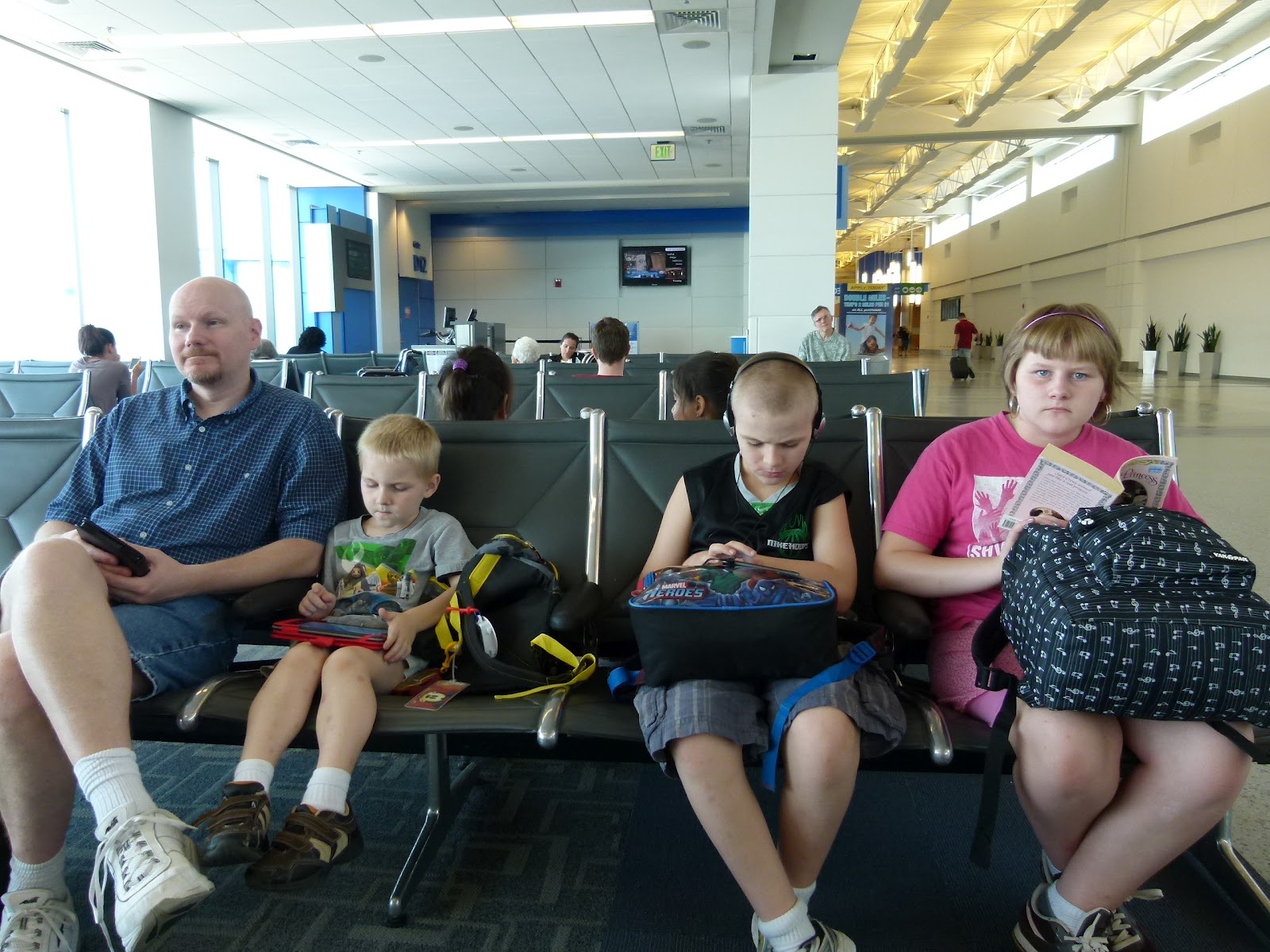
Luckily, everyone had plenty to do...
while we waiting anxiously for our plane to arrive.
This is Noah's first trip to WDW, and as soon as we got off the airplane, he found Mickey.
Then, we waited for our luggage...
then, we waited for the Disney bus to our hotel...

When we finally got to our room, we could hardly sleep as we waited some more for morning to come so we could get to a park.

Monday, August 20, 2012

Today is NOT our first day of school

It's the time of year for 'school shopping' and gearing up for the first day. For many children, today is that first day; some started last week and others will wait until after Labor Day; but, across the nation the words keep getting repeated "Today is the first day of school."
As others gear up to get started, our family is gearing up to take some time off.

We don't ever have a first day of school because we learn all year, all day, every day. Our investment in our children's education never takes a day off. It is an ongoing journey.

We do have some structured academics, and we work on those every day except Sundays. We don't rush through materials in hopes of finishing or covering it all in 180 days. Instead, we work until we've mastered it and then we go on. We don't have to finish by an arbitrary date; sometimes we're earlier or later than expected, but we get it done on our own time.

This allows us the flexibility to take vacations when others can't. And, it provides us with opportunities to turn those special vacation memories into teachable moments too. It's what inspired us to write the Vacation Education series in the first place, and keeps us returning to those lessons and the parks that inspired them time and again.

I do try to keep a general schedule of grades as the kids are often asked, "What grade are you in?" and they usually look to me for an answer and I'm left flustered trying to come up with an answer.

Just this morning, we were discussing what "grade" Jacob should be in - he's five, turning six, so is he kindergarten or 1st grade? I had to choose. We've been working out of first grade math and science books all summer long, and he'll be six before Labor Day, so I went with 1st grade. I guess I could say that today is his first day of First Grade, but that wouldn't change anything that we do all day, so what would be the point?

It's still the morning of this 'first day', but if I had sent them off to school, I already would have missed the following.

Tyler(age 11, grade 6): Mom, you know how people use abbreviations in texting and online games?
Me: Yes
Tyler: Like, LOL means laugh out loud and YLDTL means Yes, let's do that later?
Me: Okay, sure.
Tyler: What does IDK stand for?
Me: I don't know
Tyler ( in an exaggerated voice): NO ONE DOES!

A few seconds later he said: LOL

And, later Jacob (age 5, almost 6, grade 1) after listening to a book about constellations and planets, informed me of this: "God is the most powerful that there ever was and He is so powerful that He can send bad guys to Plupiter."
Me: Plupiter?
Jacob: Yes, that's a world far away from here.

Thursday, May 17, 2012

No camera = no pictures

I'm officially living up to my claim to fame as the world's worst photojournalist. I drove 20 hours with 6 kids from Michigan to Florida without a camera. I decided the big, bulky, fancy camera wasn't worth the work of hauling it and the charger for the little 'throw it in my purse and we're good to go' camera was no where to be found.
We're having a great time, but there are so many photo opportunities that I am missing.
Like, the mansion atop the mountains in Tennessee...
the many creepy, crawly things that we've seen in the "jungle yard" that we help to clear out...
the fantastic mini pool (only 1.5 feet deep and perfect for our Littles) at the hotel...
and of course the awesomeness that we will witness at LegoLand tomorrow...

I'll just have to pray that my children make enough memories to make up for Mom's lack of pictures.

Wednesday, July 27, 2011

How many days until we go to Walt Disney World?

How many days until we go to Walt Disney World?

If you are planning a trip to WDW or anywhere else, you probably hear the question, "How much longer?" over and over again... well, at least if you have kids, you do.

Here is a tip from the book  Vacation Education EPCOT. A series of Unit Studies inspired by your favorite vacation destinations.

3. Here's a tip to help keep little ones from going bonkers waiting for the big day. Cut a piece of construction paper into strips. On the first one write "We leave today" and then turn the strip so the words are on the inside, and tape the edges together. On the second strip write, "We leave tomorrow" and then loop this through the first ring and tape its edges together. Continue writing messages such as "Today we pack our suitcases, you can help" or "Only ten more days, count them on your fingers" and looping them onto the previous ring. When finished, hang this string of rings in a prominent part of the house where your children will see it every day. The last ring should be for the day you start making them. Each morning, your child can cut one down and read the message. The string of rings will be a visual reminder to help your children answer for themselves the constant questions of "How many more days until we go to Disney World?"

Now, if you are planning a surprise, you should not use this tip. One of our most memorable trips was our first. Our oldest was 6 years old, and in dance class. On the night of their final performance of the year, we dropped her off an hour before the show, and went home to pack the van. After the show, we drove as she fell asleep, still in her costume, makeup, frizzy hair and all. By the time she woke up, we were half way there. We handed her a United States map, told her the route we had driven so far, and let her guess where we were headed. It took her about two minutes to figure it out.