A couple of my friends recently shared this article on their Facebook pages. I was excited to read "Homeschooling: Win Over Your Church" because being the only homeschooling family in a congregation is a unique challenge. I was especially intrigued as I read the first paragraph and learned that the author is a pastor's wife.
But, as I read her suggestions, I thought,
THAT DOESN'T WORK!
or at least, that doesn't work for us.
Granted, this article was written about 15 years ago, and at that time homeschooling was not as common or accepted as it is today. In fact, homeschooling today is quite common in some church denominations and we know families who have chosen their church based on the homeschooling network that exists there. In fact, there was a time when I also made my decision on where to attend church based on nothing more than where my homeschooling friends attended.
Since then, I've learned a lot about doctrine and theology and I understand that every church is not the same. In choosing where to attend based on law and gospel preaching and sound teaching, I ended up back in the Lutheran tradition that my father and his father before him were raised in. Among Lutherans, Christian education is a high priority; so much so that they highly value their Lutheran school system. But, homeschooling is still in its infancy among Lutherans.
I have been the only homeschooling mom in a congregation where nearly every other child attended the attached school, in a congregation where every other child attended the small nearby public school, and in a congregation with one other homeschooling family. Today, I am married to the pastor of a congregation in a small town where everyone attends the local public school except for a few who make the drive to attend a Lutheran school in a nearby town. We are once again the only homeschooling family in our congregation.
Her first piece of advice is that "You don't have to be perfect..." and I'm going to come back to that. Her second piece of advice is "Show Off Your Home Economics Skills". When I read this, I laughed, because I have none and I have no idea what that would have to do with homeschooling unless I was trying to convince people that my daughters will one day be good hostesses.
I believe that we are all uniquely gifted and how we are able to use our gifts depends on our circumstances. Some of my friends are great at hosting and I love to visit them, and sometimes I'm a little jealous of their skills, but it's not my gift. I love to have people over, but to relax, drink coffee and share a little reality - company is a welcome interruption to my day - not a way for me to prove the benefits of homeschooling. If I had to live up to that standard, I would never allow anyone into my home.
Next, she suggests that you "Choose Appropriate Ministry Projects", and suggests things for the children to be doing. We do choose carefully what activities our children will participate in based on who they are and what they need, not based on how the congregation will perceive their faithfulness. When we serve it is for the purpose of serving, not of showing off.
She says, "Do Not Grandstand as a Leader" and she means that one shouldn't use the pulpit to promote homeschooling. Well, of course. First, I'm not going to be saying anything from the pulpit - EVER! because I'm not called and ordained. And, my husband, who is called and ordained to serve this congregation, understands full well that his vocation is to preach law and gospel to the people of the congregation. Homeschooling is not LAW, even if some Christians would like to present it as such. (Proverbs 22:6)
My experience in each new congregation is that where our kids go to school is not the first topic of conversation that people want to have with me. In most cases, it isn't something they even think of. I don't bring it up either. I mean, if your kids go to public school is that the first thing you say to someone you just met?
Usually, it takes time to get to know new people and a new area, so I'm busy asking for directions and trying to figure out who is related to who. Gradually, as friendships form, the subject comes up. We state matter of factly that we homeschool and we try to answer honestly any questions that people ask. We have found that even the most adamantly opposed to homeschooling have a hard time arguing against it when they genuinely like you and your kids.
My advice is
1. Go ahead, invite friends over. Because you like them, not because you are trying to prove something. If someone is interested in judging my housekeeping or culinary skills, they will be very disappointed.
2. Let the pastor preach and teach. Let your children be servants because God has given them a heart for service, not so that people can see what a great job you are doing.
3. Stop trying to prove something. This took me a long time to learn. If I had read this article when it was written, I would have taken all these things to heart and tried to live up to them completely. (I was kind of caught up in fulfilling the law back then - now, I understand that Christ fulfilled the law for me)
I have learned a lot about friendships over the years too. People actually like me better when I'm not trying to be perfect - isn't that strange? I used to think that I had to live up to people's expectations, but the expectations were always of my own making.
Homeschooling might be easier in a congregation where everyone else is doing it, but I go to church to receive God's gifts to His people, not to hang out with like-minded educators. That's what homeschool conferences are for. I don't need to win my congregation over to homeschooling. My vocation is as a wife and mother and that includes Proverbs 22:6, but it's not my job to convince you of that.
Friday, September 6, 2013


Sunday, August 18, 2013
Why Kids Lie book review
Every once in awhile I actually get to finish a book I'm reading. I love to discuss the books I read, and am pleased to share my thoughts with you. I just finished reading "Why Kids Lie... How Parents Can Encourage Truthfulness" by Paul Ekman, Ph.D., 1989.
There is also a 1991 edition, but I'm not sure how they compare.
I found the subtitle misleading. The emphasis of this text was on the scientific data concerning the whys of lies, particularly in children. From the first chapter on how people define a lie; for example is "I enjoyed that meal." a lie if the food was really awful? Should you lie in this case to save the feelings of the cook? How about if the cook is Gramma?
Is something a lie simply because it isn't the truth?
What about concealment? Is that lying? If you don't tattle on your friends, is that they same as lying to their parents? Is it lying if you see someone cheating and you say nothing?
Is something a lie simply because it isn't the whole truth?
If we say that anything that isn't true, or completely true, is a lie; then, do we have a hierarchy of lies that we all agree on? Is complimenting Gramma's bad cooking the same as stealing money from Gramma's purse and saying you didn't?
Do we define the lie by the truth it conceals? Does intent determine whether or not we consider a statement to be a lie? Do we consider motivation in our judgement of a lie? Are some lies more socially accepted than others? Are some lies even socially desirable?
Dr. Ekman explores the statistical analyses of children's answers to these types of questions. The first few chapters contain some interesting case studies where children's ability and willingness to lie is tested in comparison to the actual "hidden camera" behaviors of the children when tempted to lie and given opportunity.
Ekman's wife chimes in at the end with a couple of chapters from her experience as a divorce lawyer; evaluating the effects of children's lies on our judicial system and vice versa.
The only real advice for dealing with children who lie comes around the middle of the book. They recommend telling children how lies hurt others rather than simply focusing on the evil of lying. They also suggest that parents try to get to the root of the reason for the lie - such as fear of punishment. Punishment for the misdeed being covered up, such as stealing, should be separate from the punishment for the lie. Understand that all children lie for various reasons - that are explained in depth in this book - however, if the lying becomes compulsive and uncontrollable, you should seek professional help.
If you are looking for specific parenting techniques to deal with lying, you won't find them here. If you are looking for some fascinating and ground breaking science on the psychology of lying in children, this book is filled with facts and data in an area where limited research has been done.
While this book was published in 1989, Ekman's work continues to be at the leading edge of research in deception and the television show Lie To Me was based on his work.
Thursday, August 1, 2013
Homeschooling: Counting the Hours
The state of Wisconsin requires "...a minimum of 875 hours of instruction each year..." That's five (5) hours per day for one hundred seventy-five (175) days. That sounds like a LOT. I mean, that's a lot of instruction time.
The thing I like about requirements, after coming from two states that had none, is that it gives me an excuse to make my children work through the days when they just don't feel like it.
I can say, "Hey, it's not me, I would gladly let you take today off, but the state says we have to log these hours."
It's also a good excuse to get started early this year. We took some time off to move and get settled into our new home, and during this time I've been working on organizing my library and writing lesson plans. I am excited to get started. When the kids resisted, I just reminded them that have hours to log (I even made each child a piece of graph paper with their 875 squares). I said we might as well get a head start or we'll be crying in June when all our friends are done and we're still trying to fill in our squares. They relented, and the school year began.
So, I'm thinking about these little squares and wondering, besides sitting at the table while I talk at them, what activities do we count as worthy of filling in a square? What hours count as "hours of instruction"?
I had planned for today to be a day off, so no hours to log, right? We did our household chores - I scrubbed the grout on my kitchen floor and it's awesome... but, that's a blog for another day. After chores, we spent the rest of the day at the beach. That's not "instruction" is it?
But, then, Noah learned how to catch frogs, and how to let them go. Life Science
Jacob learned that somersaults in the sand and somersaults in the water are entirely different things, but both are fun. Gravity, water tension, buoyancy...
Ethan learned to use his goggles without letting them fill up with water. suction, air pressure, water...
pressure...
Tyler learned how to identify the backs of snails in the dirt and recognize them among the rocks, and when he accidentally swallowed some water that he was sure had a minnow in it... our day quickly led to a lesson in the human digestive system. Geology, biology
Caitlin found a clam? or maybe an oyster? that she brought home and dissected in hopes of finding a pearl. biology with lab


How can I not count these as "hours of instruction"? With this in mind, I wonder what will happen when I've chalked up 875 boxes and I still want them to sit at the table and listen to me talk at them... How will I convince them to go along? It may be time to hide the graphs.

BTW: We confirmed that Caitlin's catch was a clam, so no pearl, but she did get a pretty neat souvenir shell.
The thing I like about requirements, after coming from two states that had none, is that it gives me an excuse to make my children work through the days when they just don't feel like it.
I can say, "Hey, it's not me, I would gladly let you take today off, but the state says we have to log these hours."
It's also a good excuse to get started early this year. We took some time off to move and get settled into our new home, and during this time I've been working on organizing my library and writing lesson plans. I am excited to get started. When the kids resisted, I just reminded them that have hours to log (I even made each child a piece of graph paper with their 875 squares). I said we might as well get a head start or we'll be crying in June when all our friends are done and we're still trying to fill in our squares. They relented, and the school year began.
So, I'm thinking about these little squares and wondering, besides sitting at the table while I talk at them, what activities do we count as worthy of filling in a square? What hours count as "hours of instruction"?
I had planned for today to be a day off, so no hours to log, right? We did our household chores - I scrubbed the grout on my kitchen floor and it's awesome... but, that's a blog for another day. After chores, we spent the rest of the day at the beach. That's not "instruction" is it?
But, then, Noah learned how to catch frogs, and how to let them go. Life Science
Jacob learned that somersaults in the sand and somersaults in the water are entirely different things, but both are fun. Gravity, water tension, buoyancy...
Ethan learned to use his goggles without letting them fill up with water. suction, air pressure, water...
pressure...
Tyler learned how to identify the backs of snails in the dirt and recognize them among the rocks, and when he accidentally swallowed some water that he was sure had a minnow in it... our day quickly led to a lesson in the human digestive system. Geology, biology
Caitlin found a clam? or maybe an oyster? that she brought home and dissected in hopes of finding a pearl. biology with lab

This group looks like a class to me.

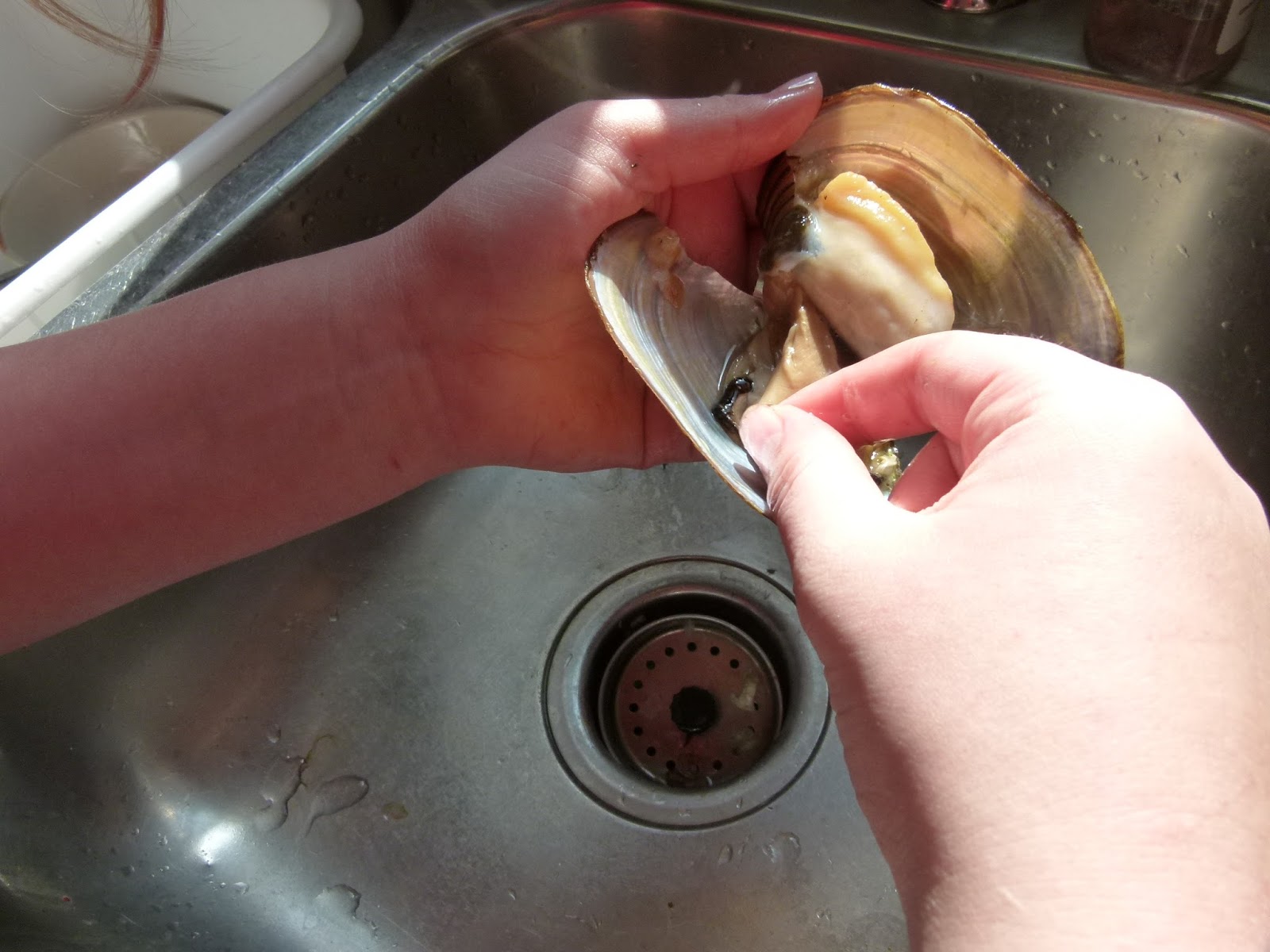
I've never dissected a clam before...

"Can we make clam chowder?"

"Whoa! Intestines??"
How can I not count these as "hours of instruction"? With this in mind, I wonder what will happen when I've chalked up 875 boxes and I still want them to sit at the table and listen to me talk at them... How will I convince them to go along? It may be time to hide the graphs.

BTW: We confirmed that Caitlin's catch was a clam, so no pearl, but she did get a pretty neat souvenir shell.
Subscribe to:
Posts (Atom)